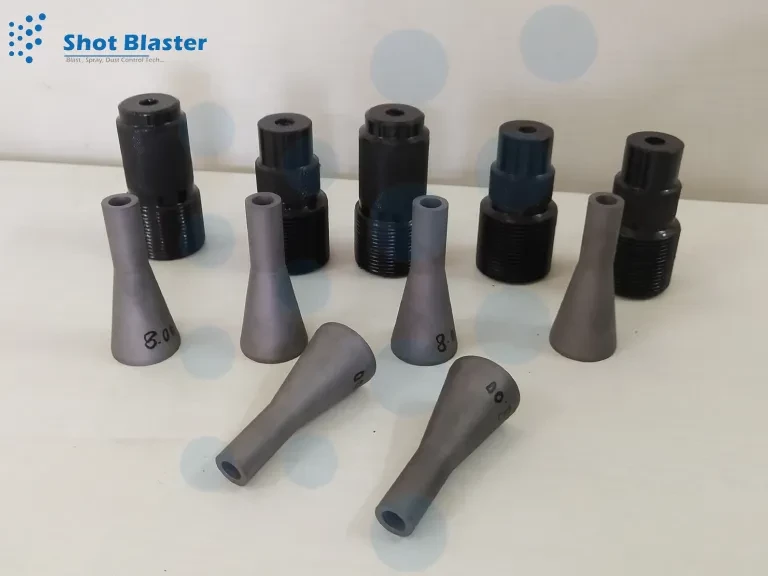
Applications of Sand Blasting Nozzle
- For a range of tasks like sandblasting, burr removal, and other uses, tungsten carbide nozzles are frequently used in surface treatment, sandblasting, electronics, chemical processes, and other sectors.
- Sandblasting nozzle material is very durable, so it is widely used in abrasive blasting industries in India
- The Sand Blasting Nozzle is sturdy, abrasion- and corrosion-proof.
- Almost all air-operated sand-blasting machines use a sandblasting nozzle to deliver abrasive material.
Sand Blasting Nozzle Details
A Sand blasting Nozzle life is very hard for one to predict accurately because of the many features such as the vast range of abrasive media such as silicon carbide, aluminum oxide, steel shots, glass beads, and so on being used, their sizes, their different shape, their hardness, varying air pressure coming at the nozzle for sand blasting machine, The Sand blast nozzle tips bore size and blasting nozzle mouth diameter during blast hose life, methods of abrasive media cut-off or machine shut-down. Sand Blasting Nozzle size is of varying shapes used to blast different patterns on the surface.
When selecting a nozzle for sand blasting machines & shot blasting machine there should be a balance to be kept in mind, and it starts with our air compressor (air consumption). Once we understand how the size of our compressor for sand blasting nozzle air consumption affects production capabilities, then we will look at tungsten carbide nozzle size.
The next consideration is the Sand Blasting Nozzle size & shape. Sand blasting nozzles are two types these are shapes of straight bore and venturi blast nozzle is of multiple sizes and with various different patterns. Lastly, we want to consider the material from which the nozzle is made of. The three main factors in selecting the ideal air blast nozzle for sandblasting bore material are durability, impact resistance, and price.
The more air volume compressed per minute, the higher the pressure produced at the air blast nozzle. This improvises the production rate in two ways:
- High pressure increases the velocity of abrasive media particles, delivering more kinetic energy upon the surface blasting, imparting a deeper anchor pattern. This allows us to use a finer grade of abrasive media, which produces more impacts per volume on blasting surfaces.
- More air capacity allows us to use a bigger bore of the nozzle for sandblasting, which lets us put more abrasive material on the target surface.
Available sizes - 5mm to 10mm
- TC Nozzles (Tungsten Carbide) Long & Short
- BC Nozzles (Boron Carbide) Long & Short
- SS Nozzles for Y-Gun.
Different Sizes of Sand Blasting Nozzle
For sand abrasive blasting, the most commonly-used air nozzle from 3/8" inner diameter to 3/4", increasing by increments of 1/16". An 8mm air blast nozzle is constructed to generate pressure at a 120 CFM air compressor. A 10 mm sand blasting nozzle is enough to generate an effective blasting pressure at a 210 CFM air compressor.
It’s important to notice that when we double the diameter of the orifice, we quadruple the size of the orifice and the volume of air and abrasive media that can pass through the sandblasting nozzle.
To find our optimally productive Sand Blasting nozzle, determine what nozzle pressure (PSI) we need to maintain for the productive blaster, and Sand Blast nozzle air consumption or what volume of air our available air compressor can supply per minute (CFM).
Types of Sand Blasting Nozzle
Sand blasting Nozzles are of two basic shapes: straight bore and Venturi, there are several different variations in venturi nozzles. Let's check it out:
Straight Bore Nozzle
As compressed air enters the converging (left) end of a straight bore nozzle it accelerates, accelerating the abrasive media particles suspended in the flow. These abrasive media particles exit the nozzle in a tight stream and produce a narrow, concentrated blasting pattern upon the impact surface.
Venturi Blasting Nozzle
Blast Pattern: 3" at 18" distance
Production Rate: 4.5/5
Venturi nozzles have a converging entry and a diverging exit. This shape is designed to produce an effect that greatly accelerates the airflow and media particles.
The Venturi effect is an observation that when an airflow accelerates while passing through construction, there is a corresponding drop in pressure level.
Besides producing tremendous acceleration, the angled shape nozzle of the diverging end spreads out the flow, producing a large blast pattern and a more uniform particle distribution than a standard bore nozzle.
Long Venturi nozzles give up to 40% better production rates and consume less abrasive material compared to straight bore nozzles.
Double Venturi Nozzle
Blast Pattern: 3" at 18" distance
Production Rate: 4/5
A double Venturi nozzle is with an extra-wide exit opening and holes at the diverging end.
According to the Venturi effect, as the velocity of the flow increases, the pressure drops, creating a vacuum between the shockwave and the throat, reducing abrasive material velocity. With a double Venturi type nozzle, atmospheric air is inserted through the holes into the low-pressure area, expanding the airflow to produce a huge blast pattern on the blast surface.
Wide Throat Nozzle
Blast Pattern: 3" at 18" dist.
The Rate of Production: 5/5
Wide throat nozzles are a wide throat and an extra-1/4" wide converging section. When used in coincidence with a hose pipe with a matching inside diameter (and with a corresponding air volume increase), the wide throat nozzle can improve productivity level up to 15% over a long Venturi nozzle.
XL Performance
Blast Pattern: 5" at 48" distance
The Production Rate: 3/5
These are extra-long nozzles accelerating media particles over a longer distance, achieving higher exit velocities, allowing the blaster to stand further back from the surface being blasted, and producing a larger blast pattern and higher production rates.
Material used in sand blasting nozzle
The third consideration while choosing a nozzle is the material of the lining inside the bore. Harder materials will be more extra to wear but are more expensive to replace and are prone to cracking under rough handling. There are two basic types of nozzle and their details.
- Tungsten carbide nozzle
- Boron carbide nozzle
Tungsten carbide nozzle
Durability: 1/5
Impact Resistance: 5/5
Price: Low
This tungsten carbide nozzle is the least durable of the carbide nozzles, but relatively less costly and resistant to impact. Mostly suitable for blasting with copper slag, glass, and mineral abrasive media.
Boron carbide nozzle
Durability: 3/5
Impact Resistance: 1/5
Price: High
Boron carbide nozzle is extremely hard and durable but brittle in nature. It can give up to ten times the longevity of tungsten carbide.
Sand Blasting Nozzles price in India
Sand Blasting Nozzles price depends on the type & material of the nozzle. We offer a variety of sand blasting nozzle at a low price for sale. Shot Blaster is a Leading Manufacturer & Suppliers of sand blasting machine, grit blasting machine, thermal spray gun, & metalizing gun.
All of these Tungsten Carbide & Stainless Steel items are available in a variety of sizes, shapes, grades, and specifications to meet the needs of our customers. We also provide shot blasting equipment to customers in India and other countries. The key to our success has been a strong focus on innovation and a thorough grasp of our clients' needs. We have never cut corners when it comes to the quality of our services.