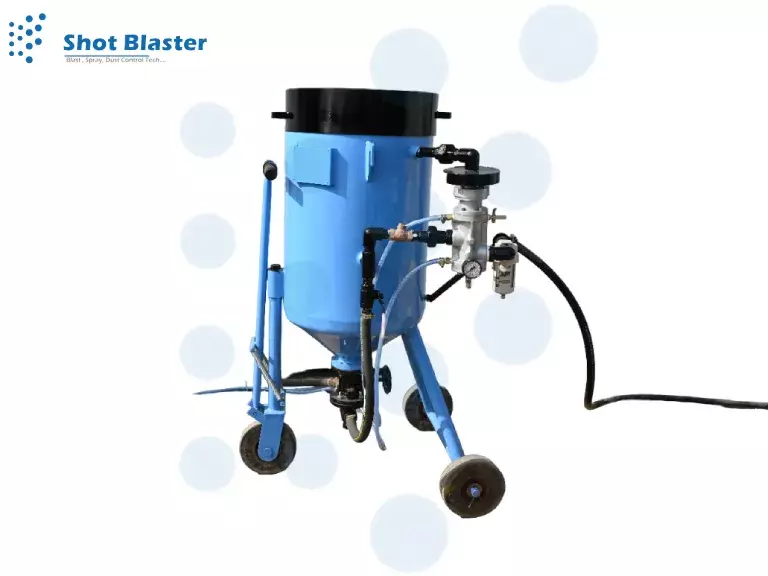
Sand blasting machine is used for cleaning & removing unwanted contaminants on the surface of the subject using abrasive media. This abrasive material is sprayed on the surface of the subject for cleaning. In abrasive we can use various types of abrasive like glass beads, garnet sand of different mesh (10/30, 20/40, 30/60, 80) plastic beads, steel grit, aluminum oxide, silicon carbide, etc.
Three types of sand blasting machine are the following:
1.) Wet sand blasting machine:
The wet sand blasting machine is a self-contained system that uses a slurry of Abrasive Media & water to clean, descale and degrease surfaces in a single operation. The slurry is directed through a special high volume pump to blast a gun with abrasive which is regulated air pressure adjusts the aggressiveness of the process. The process is free of dust and a close-loop. Water acts as a buffer catalyst between metal & media to cushion the shock on delicate components.
Applications:
- Paint removal, rust removal & corrosion removal.
- Casting Cleaning
- Ship hull cleaning
Advantages:
- Because of the water ingredient, it will not create any environmental pollution problem caused by fluttering the micropower.
- It doesn't require any chemicals during the operation.
- It doesn't affect the dimensions of the object.
Limitations:
- Though water consumption is not too high, it is to be taken into account to dispose of it or recycled.
2.) Suction sand blasting machine:
Suction sand blasting machine are the most common blasting machine used in several organizations. Its cabinet has 2 hoses attached and one delivering compressed air, one vacuum hose drawing abrasive into the section gun of this sand blasting machine. Meanwhile, its Pressure-blast nozzles have one larger hose to deliver a mixture of media particles while doing sand blasting.
Applications:
- Clean & peen precision parts
- Produce and anchor pattern ideal for uniform finishing
- Deburr machined parts
Advantages:
- It only applies a small shot blasting effect to the surface to be finished and improve and reinforce the material of the workpiece.
- The foreign materials after being removed will be rinsed and flushed out by a jet of water.
Limitations:
- An anti-rust inhibitor is to be used after cleaning of ferrous material.
3.) Pressure sand blasting machine:
This surface pressure blaster is from the family air-operated pressure sand blasting machine and is suitable for units with moderate output. The abrasive stream is propelled with high-velocity air current creating abrasion on the components. The components shall be exposed to the blast stream by maneuvering it under the blasting Stream. If the components are bigger they can be kept on the floor of the blast cabinet or on a rotary table provided as an optional accessory. This machine is manually handled due to air operated machine. In this machine, the component is placed inside the cabinet.
Application:
- Blend light scratches and tool marks
- Deflash plastic and metal parts
- Stone cleaning/designing
Advantages:
- It can remove by the burrs (surface projections) & scales formed on the surface and clean the surface without damaging the workpiece.
- The surface finishing can access a homogeneous matte finish (spot pattern).
Limitations:
- The surface roughness is more than dry sand blasting.
